Bowel Transit Time Test

A simple at-home corn test to measure how long food takes to travel through your digestive tract.

What Is Transit Time?

The time it takes for food to move from your mouth all the way through your digestive system.

Bowel transit time is one of the simplest, most useful markers of digestive health. A slow transit time means stool spends longer in the gut, which can contribute to bloating, discomfort, and constipation. A balanced transit time supports regular elimination and a healthier microbiome.

The corn test is an easy, food-based way to measure your transit time at home without having to spend money on lab testing
How to Do the Test

Four simple steps using corn as a visual marker.

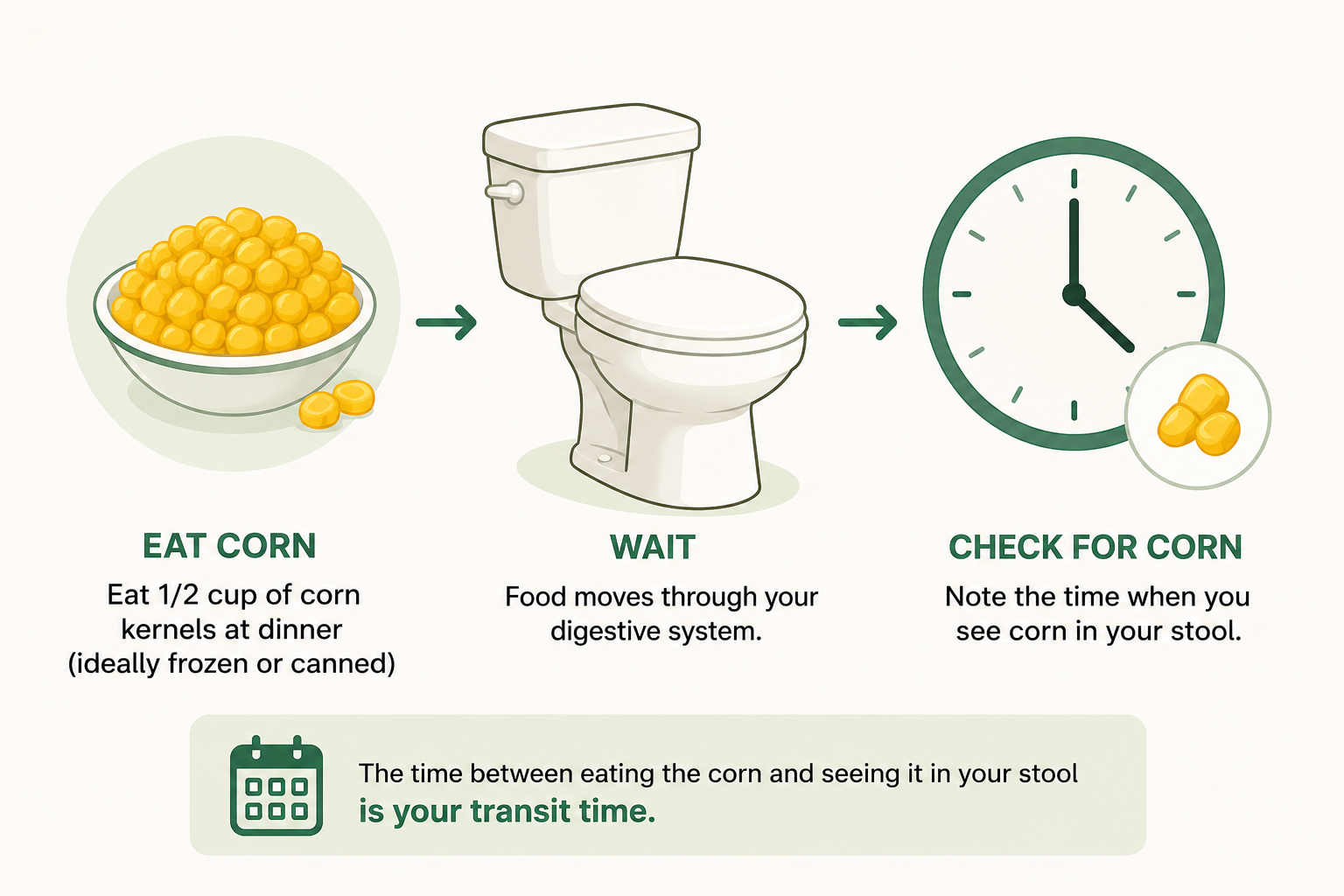
Illustration showing the three steps of the transit time test: eat corn, wait, then check for corn

Step 1 — Eat the Corn

At dinner, eat ½ cup of corn kernels (canned or frozen/reheated). You can mix the corn into a meal or eat it on the side. If eating it on the side, chew only enough to swallow.

Step 2 — Record the Time

Write down the date and time you ate the corn. You can use your phone, a notes app, or a bowel movement tracking app.

Step 3 — Watch for the Kernels

Watch for corn kernels in your stool over the next few days. The kernels may appear lighter in color, and you may only see a small amount. This is completely normal.

Step 4 — Calculate Your Transit Time

Your transit time is the amount of time between eating the corn and seeing the last of the corn pass in your stool.

Example

If you eat corn on Monday at 6:00 PM and stop seeing corn in your stool on Wednesday at 8:00 AM, your transit time is 38 hours.

How to Interpret Your Results

Compare your transit time to these general ranges.

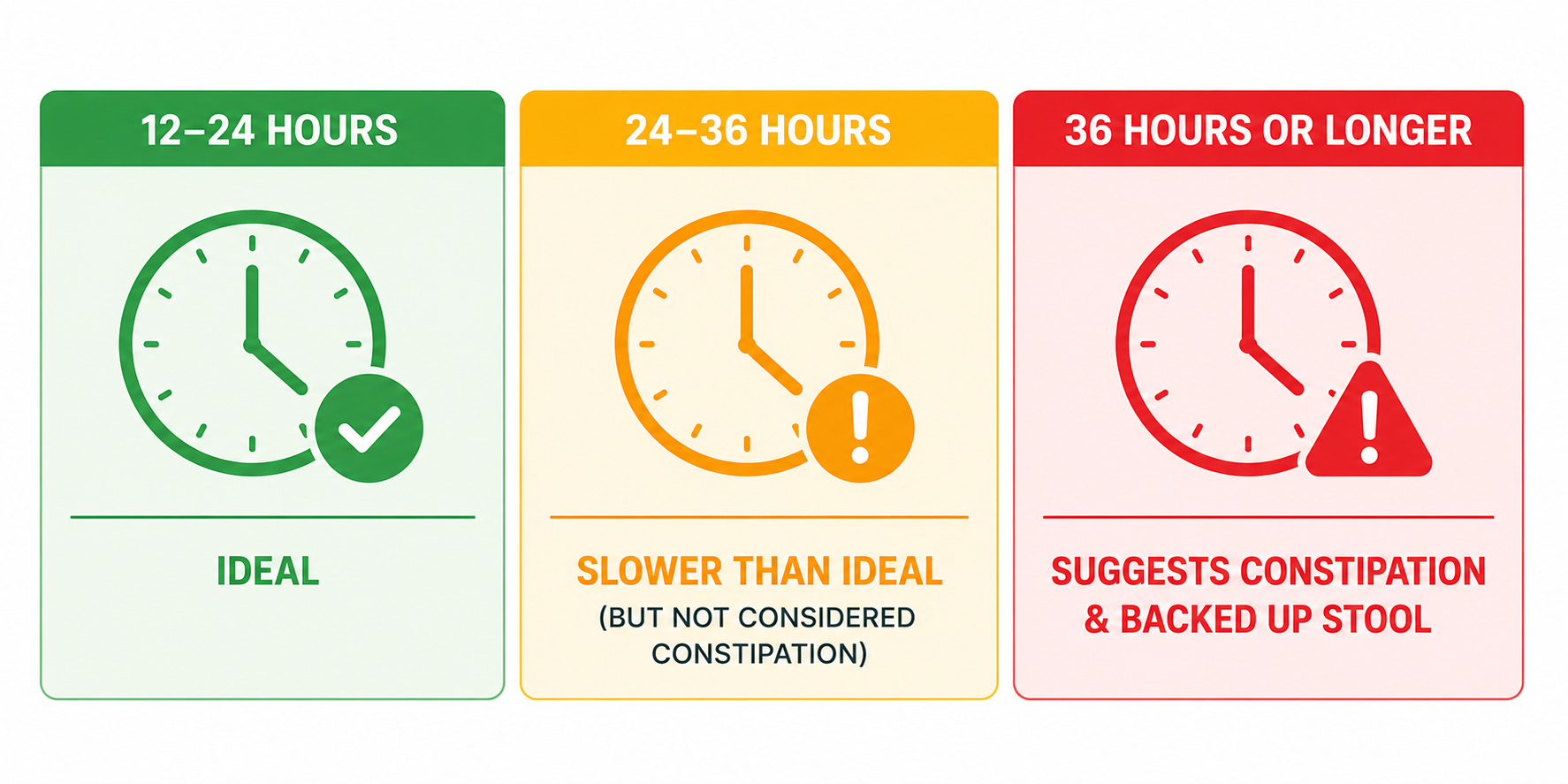
Three result ranges: 12-24 hours ideal, 24-36 hours slower than ideal, 36 hours or longer suggests constipation
12–24 hours
Ideal
24–36 hours
Slower than ideal (but not considered constipation)
36 hours or longer
Suggests constipation & backed up stool

What Your Results Mean

Putting your transit time into context.

In general, the longer your transit time, the more backed-up stool may be present in the digestive tract.

If your transit time is prolonged, a bowel "clear out" may be recommended before starting a daily motility supplement.

Track Your Progress

We recommend repeating this test every 2–4 weeks to track your progress over time.

Constipation Rescue & Clear Out Guide

Step 1: Determine Whether A Clear Out Is Necessary

Consider a clear out if:

  • Transit time is ≥36 hours
  • AND/OR
  • You are experiencing:
  • Infrequent bowel movements (<1/day)
  • Significant straining
  • Incomplete evacuation
  • Hard stools
  • Feeling "backed up"
  • Persistent lower abdominal distension
  • Imaging showing stool burden
  • No improvement despite daily bowel support

Do NOT Perform A Clear Out If You Have:

  • Severe abdominal pain
  • Persistent vomiting
  • Inability to pass gas
  • Blood in stool
  • Unexplained weight loss
  • Known bowel obstruction
  • Recent abdominal surgery
  • Active IBD flare
  • Kidney disease (for magnesium protocols)

Seek medical attention if these are present.

Choosing The Correct Clear Out

Transit Time 36-60 Hours

Option A (Preferred First Choice)

Magnesium Citrate Rescue

For otherwise healthy adults:

  • Shake bottle well before drinking.
  • Take first thing in the morning.
  • Remain near a bathroom.
  • Hydrate aggressively.

Transit Time >60 Hours

Option B (Preferred)

PEG (Miralax/Restoralax/Macrogol) Rescue

Mix:

  • 119 g PEG (half of a standard 238 g bottle)
  • Into 32 oz water

Drink:

  • 8 AM: 8 oz
  • 8:30 AM: 8 oz
  • 9 AM: 8 oz
  • 9:30 AM: 8 oz

Most people respond within 2-12 hours, though some may not respond until the following day.

Severe Stool Retention / Prior Failure

If you have:

  • Transit time >60 hours
  • Severe methane constipation
  • Known fecal loading
  • Prior PEG failure

You may consider:

PEG protocol + 2 Dulcolax (bisacodyl) tablets

  • Take 1 tablet with first PEG dose
  • Take 1 tablet with second PEG dose
  • Use only occasionally.

During A Clear Out

Do

  • Stay home
  • Drink 3-4 L fluids
  • Use electrolytes
  • Eat normally
  • Continue walking and gentle movement
  • Consider abdominal massage and use a squatty potty

Avoid

  • Fasting
  • Restricting food
  • Repeating clear outs multiple days in a row
  • Performing >3-4 major clear outs/year without professional guidance

When To Restart Maintenance Therapy

Resume your usual bowel support the following day:

Examples:

  • Mag07
  • Magnesium Citrate
  • Motility agents
  • Ginger
  • Prucalopride
  • Iberogast

Re-Test Transit Time

Repeat your transit time test 2–7 days after the clear out.

Success =

  • Transit time <24 hours
  • Easier bowel movements
  • Less stool burden
  • Less lower abdominal distension

If The Clear Out Does Not Work

If:

  • No response
  • Minimal stool output
  • Transit remains >36 hours

Consider:

  • Escalating from magnesium → PEG.
  • Increasing maintenance bowel support for several days.

Investigating other possible root causes:

  • methane SIBO
  • pelvic floor dysfunction
  • hypothyroidism
  • medication side effects
  • inadequate intake
  • dysautonomia
  • colonic inertia

If multiple rescue attempts fail, further medical evaluation is warranted.

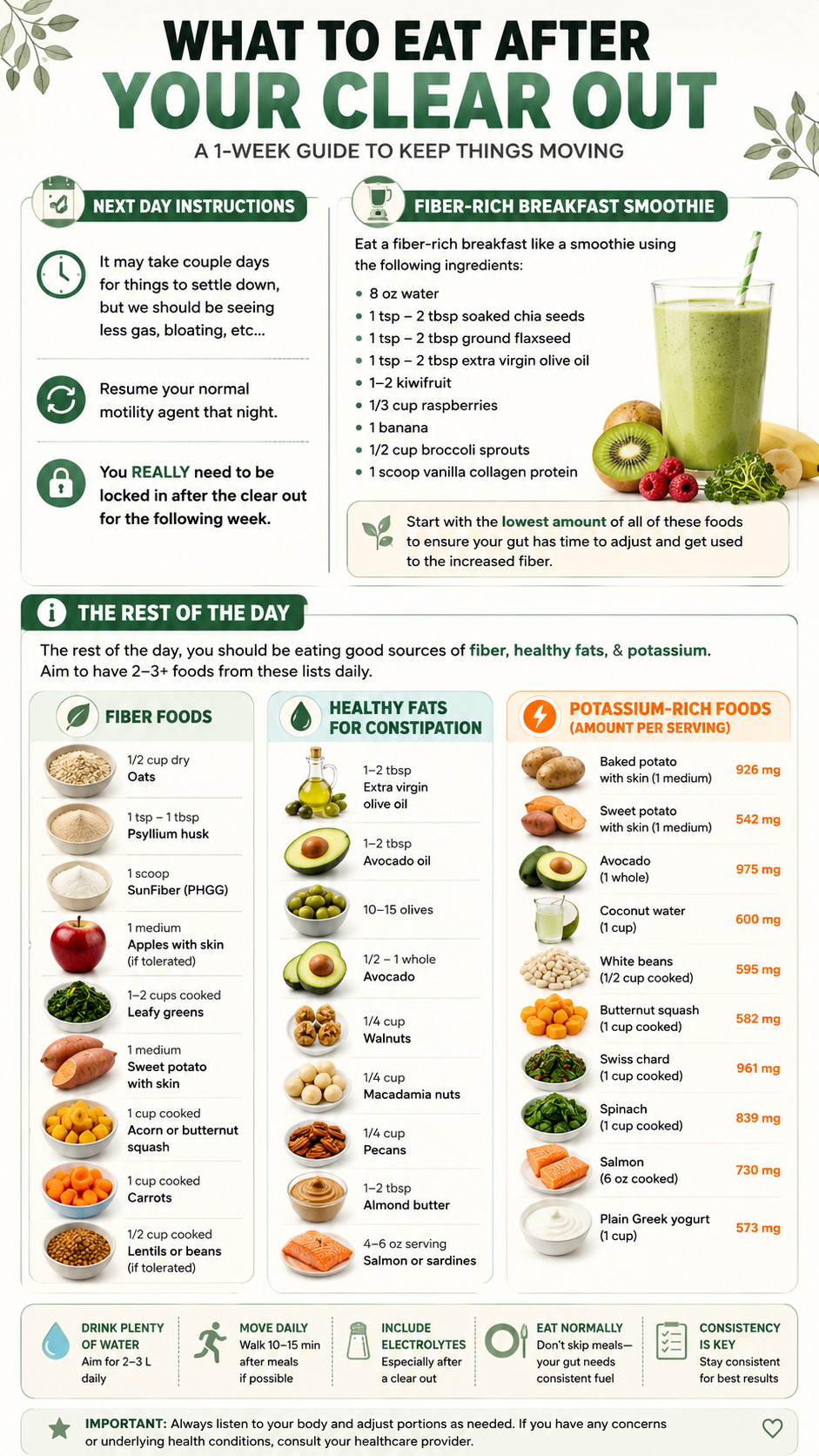
Next Day Instructions

It may take a couple days for things to settle down, but we should be seeing less gas, bloating, etc…

Resume your normal motility agent that night:

  • Mag07
  • Magnesium Citrate

For the next 7 days, it’s CRUCIAL to be locked in with your diet, hydration, and morning routine to take advantage of the clear out and normalize your bowels.

Fiber-Rich Breakfast Smoothie

Eat a fiber-rich breakfast like a smoothie using the following ingredients:

  • 8 oz water
  • 1 teaspoon – 2 tablespoons of soaked chia seeds
  • 1 teaspoon – 2 tablespoons of ground flaxseed
  • 1 teaspoon – 2 tablespoons of extra virgin olive oil
  • 1–2 kiwifruit
  • 1/3 cup raspberries
  • 1 banana
  • 1/2 cup broccoli sprouts
  • 1 scoop vanilla collagen protein

Start with the lowest amount of all of these foods to ensure your gut has time to adjust and get used to the increased fiber.

The Rest of the Day

The rest of the day, you should be eating good sources of fiber, healthy fats, & potassium. Aim to have 2-3+ foods from these lists daily.

Fiber Foods

  • Oats (½ cup dry)
  • Psyllium husk (1 teaspoon–1 tablespoon)
  • SunFiber (PHGG) (1 scoop)
  • Apples with skin (1 medium, if tolerated)
  • Leafy greens (1–2 cups cooked)
  • Sweet potato with skin (1 medium)
  • Acorn or butternut squash (1 cup cooked)
  • Carrots (1 cup cooked)
  • Lentils or beans (½ cup cooked, if tolerated)

Healthy Fats for Constipation

  • Extra virgin olive oil (1–2 tablespoons)
  • Avocado oil (1–2 tablespoons)
  • Olives (10–15 olives)
  • Avocado (½–1 whole avocado)
  • Walnuts (¼ cup)
  • Macadamia nuts (¼ cup)
  • Pecans (¼ cup)
  • Salmon or sardines (4–6 oz serving)

Potassium-Rich Foods

  • Baked potato with skin (1 medium) — 926 mg potassium
  • Sweet potato with skin (1 medium) — 542 mg potassium
  • Avocado (1 whole) — 975 mg potassium
  • Coconut water (1 cup) — 600 mg potassium
  • White beans (½ cup cooked) — 595 mg potassium
  • Butternut squash (1 cup cooked) — 582 mg potassium
  • Swiss chard (1 cup cooked) — 961 mg potassium
  • Spinach (1 cup cooked) — 839 mg potassium
  • Salmon (6 oz cooked) — 730 mg potassium

A simple rule of thumb after a clear out is to aim to include at least 2–3 potassium-rich foods daily, as adequate potassium intake can help support healthy muscle contractions and bowel motility.

What to eat after your clear out - a 1-week guide to keep things moving